Mounds of broken shells and rocks poke their sharp edges into my feet as I gingerly walk toward the spot where my husband and son are searching for shells. The beach near our house has been slowly eroding over the past few years, and now, this part of the beach is no more than a rocky strand curving around scrubby palm bushes and other wild brush.
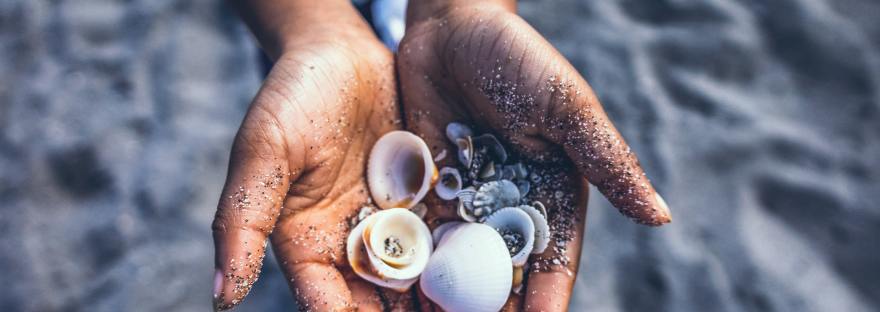
The spot we gravitate toward is marked by a rugged sea grape tree that clings stubbornly to a bit of sandy earth that is still left, even after so much has been washed away. In the shade of this tree, between the broken bits and pieces of rock and shell, we find breathtaking beauty—tiny spiraled auger shells, delicate scallop shells with soft brown and white starburst stripes, even small conch shells polished to a burnished luster by the salt and the sand.
Today, as we walk this familiar spot, I pull my phone from my pocket to take a Skype call from my husband’s parents who live in Romania. Suddenly a window opens from our shining world of blue sky and white sand to theirs, a small room lit by LED light where my father-in-law reclines in a rudimentary hospital bed. We talk nearly every Saturday morning, especially since my father-in-law’s diagnosis with ALS.
Each week, we find little bits of our lives to talk about, distraction for my father-in-law who is steadily struggling with new pain and weakness by the day. This particular talk, I turn the phone toward the place where my husband and son are rummaging for shells, let my in-laws see the size of the foamy waves that are steadily beating the shore, and marvel with them at the way the beach has been worn away since they were last here with us.
Nearby our spot, a sign that used to warn of “No lifeguard on duty” lays on it’s side, with a post the size of a telephone pole splintered by the powerful tides.
We look forward to these calls, savoring the time that we still have to see their faces, to help my son make memories with them both. We talk about the comfortingly mundane parts of our lives—an unusually hot day, a new haircut, how long it’s been since it rained last, the recipe for a Romanian fried bread that my son loves.
When the call is done, we go back to our searching, eagerly stuffing our pockets with the treasure we find among the rubble. After a bit, I take a break to stand and watch the water. I try to steady my breathing by inhaling with the rush of the waves on the shore and exhaling as they recede.
—
Over the next several months, we spend many mornings visiting with my in-laws, our hearts growing heavier by the day. We find ourselves at that rocky beach again and again, sometimes in bright morning sunlight, but more often as the sun recedes and stains the Easter-egg sky with pink, purple, and orange.
As I walk, I am always drawn to prayer by the steady presence of the sea. Its magnitude, its beauty, its depth brings to mind how far God’s ways are above my own, and yet its reliable ebb and flow right at my feet reminds me of how near he is. I bring him mostly questions these days, asking for help, pleading for guidance, questioning his reasons and his timing.
As I turn to watch the waves crashing toward the sand, I don’t immediately hear any answers, but my pulse slows and I exhale longer. With my feet in the grit, I remember how Jesus walked hot sandy roads and ached at the sickness and suffering he saw all around him, shedding tears, healing, restoring. His deep mercy calls to the deep pain in my heart as the waves crash on the shore.
The water makes a soothing sound, like a parent shooshing an inconsolable infant, and I find myself exhaling more deeply and my pulse settling in the warm embrace of the shoreline.
—
Several months pass, and we receive the Skype call we have been dreading since my father’s diagnosis. Tear-stained faces encircle my father-in-law, his breathing ragged as he reaches his final hours. Impossible loss. Heartache, tears, and regrets swirl as we grieve from a distance, unable to board a plane to cross the ocean and attend the funeral in a world brought to a halt with new strains of Coronavirus.
We find ourselves in a season of broken shells–broken bodies, broken plans, broken hearts.
As we slowly and gingerly walk over the sharp edges on our path through grief, many evenings find us back at the beach, remembering what we have lost. We gather shells from between the rocks as the tide pulls away and watch translucent hermit crabs scuttle like ghosts over the sand.
—
One evening, months later, we pull into the parking lot and walk the small path through the brush onto the beach. To our utter amazement, we find the beach changed.
In the time that has passed since our last visit, a renovation has taken place. Crews have worked to pull sand in from the ocean floor and rebuild our rocky shoreline. White, powdery sand draws our eyes up and out from the line of scrubby trees where we usually walk, to the waterline, over 200 feet away.
Immediately, these verses from the Psalm 18 rush to mind:
“They confronted me in the day of my calamity,
but the Lord was my support.
He brought me out into a broad place;
he rescued me, because he delighted in me.”
Although it seems impossible, our beach has become a broad place again. The sand is a soft cushion for our tired feet, and it draws us in, calling us to walk down by the water. There, as we stand at the shoreline, the waves meet us—ever powerful, steady, comforting.
I breathe a prayer of thanks into the salty air, and in the stillness, my soul finds its rest again.

 Emmanuel Even Now